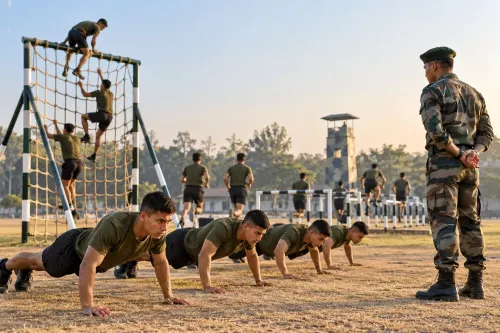


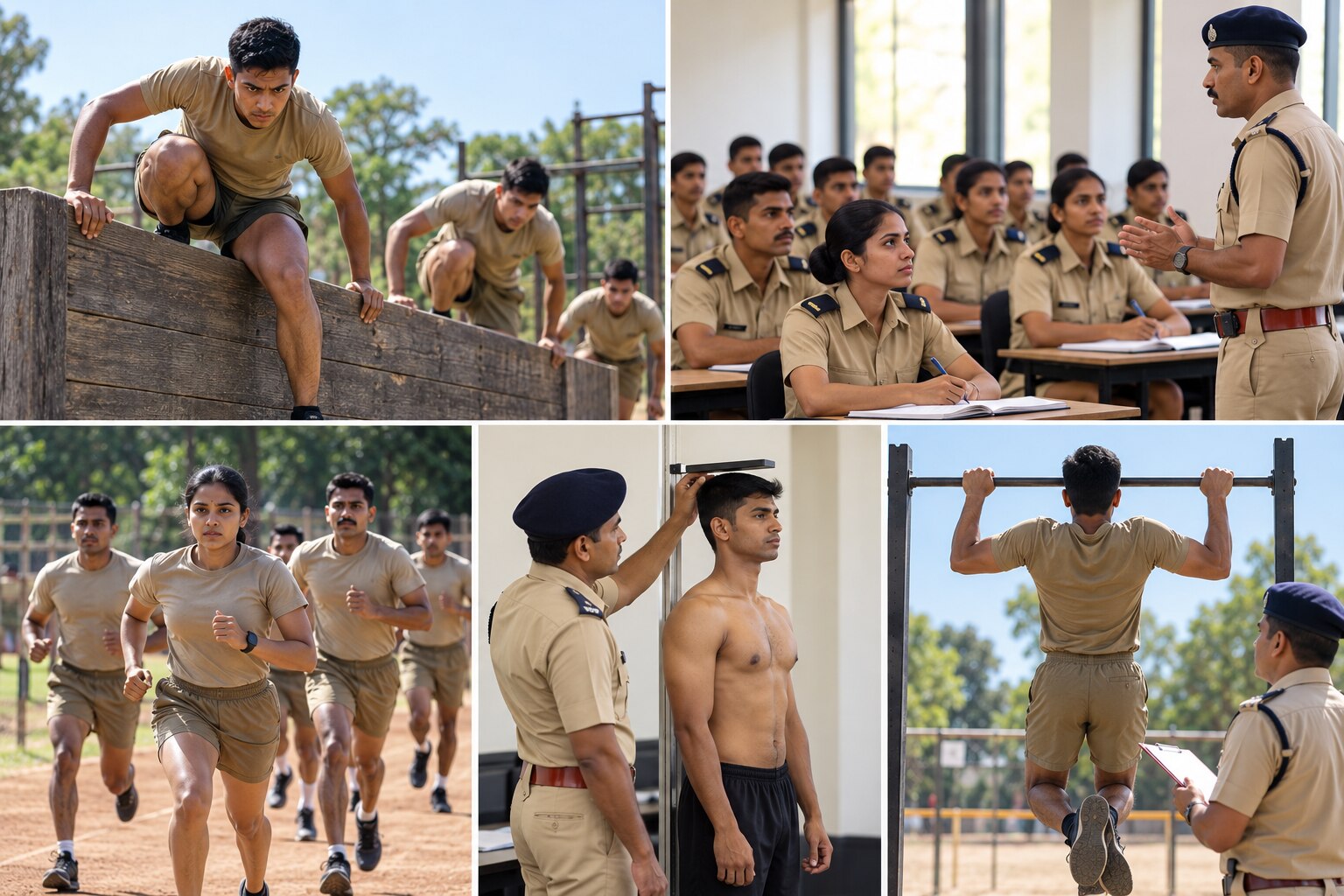
A police-training programme should prepare you for more than a morning run: each recruitment has its own physical events, measurement rules, medical standards and written-paper pattern. By the end, you will know what to ask an academy to measure, teach, record and verify before you commit to a training plan.
Key takeaways
- Treat PET, PMT and the medical examination as separate qualifying stages.
- Ask for a weekly plan that records running times, repetitions and recovery days.
- Check attendance rules, equipment, injury protocols and heat-safety measures before enrolling.
- Confirm mock tests, document checks and medical-exam guidance are included.
What physical standards apply to RPF, SSC GD and Maharashtra Police Bharti?
A Physical Efficiency Test measures performance: running, sprinting, jumping or throwing. A Physical Measurement Test checks body standards such as height and chest; a recruitment medical examination checks eyesight, colour vision, musculoskeletal fitness and general medical fitness. Passing one does not replace another.
| Recruitment | What to verify |
|---|---|
| RPF Constable | Read the current RPF notification for male and female running distance and time, height, chest measurement, and any long-jump or high-jump standards. Do not treat figures from an old cycle as permanent. |
| SSC GD Constable | Check category-specific height, male chest measurement and expansion, and race distance and time. The notice lists relaxations or separate standards for ST candidates, specified hill or tribal areas, Ladakh and other listed groups; female candidates have separate race and height rules, with no male chest test. |
| Maharashtra Police Bharti | The commonly used Maharashtra Police Bharti physical test combines a 1,600-metre run for men, an 800-metre run for women, a 100-metre sprint and shot put. Marks follow performance bands, not simply pass or fail. |
For a 1,600-metre run police recruitment test, endurance alone is insufficient: sprint speed and shot-put technique also affect Maharashtra marks. Driver Constable, Armed Police and related posts can add driving, technical or post-specific requirements.
The advertisement for your recruitment cycle controls distances, times, marks, sequence and qualifying rules. Written-test success does not compensate for failing an individual physical requirement. Check the exact notice before training to a target.
How does an academy turn your current fitness into a weekly progression plan?
A police physical training plan starts with measured evidence, not a guess about your fitness. Trainers record a 1,600-metre or 800-metre trial for the target test, a timed 100-metre sprint, the required standing or running jump, shot-put technique and distance, height, chest measurement, mobility, push-ups or core strength, and previous injuries.
- Complete the baseline on a measured track using the test’s event rules.
- Mark the throwing sector accurately; use consistent timing rather than GPS, informal ground markings or different timers.
- Record the date, event, time or distance, repetitions, technique faults, pain and recovery status.
A running progression then divides the week between aerobic endurance, acceleration and sprint mechanics, explosive throwing strength, lower- and upper-body strength, running drills, flexibility and recovery. The 100-metre sprint training and shot put preparation need dedicated practice; long-distance running alone will not protect those marks.
Increase one load at a time: raise distance before speed, or strength volume before adding harder event practice. Raising distance, speed and strength together increases shin, knee and hamstring problems.
Each week, the instructor compares results with the previous record and adjusts intervals, recovery periods, strength volume and event-specific practice. A slower time with poor recovery calls for more rest, not maximum effort. Technique faults can require shorter sprints or lighter throwing drills before intensity rises.
Near a scoring boundary, measured conditions matter because small timing or distance errors can change your result.
What should the daily schedule, attendance rules and equipment look like?
A police academy daily schedule should alternate hard running, sprinting and throwing with lower-intensity or recovery days. Strength training, mobility work and flexibility exercises can fill other sessions without making every day maximal.
A 5:30 a.m. physical training session can be followed by study-room work in mathematics, reasoning, Marathi grammar and general knowledge. Add timed practice on selected days, not after every exhausting field session, so fatigue does not turn written preparation into passive reading.
Ask about the academy attendance requirements before enrolling. If you miss the early session, confirm whether an alternate batch, supervised make-up workout or home plan exists, whether the absence appears in your attendance record, and whether it affects tests or eligibility for practice.
Ask the academy to write down the ground kit contents rather than assuming “kit” includes shoes or safety gear:
- Properly measured running shoes
- Sports clothing and socks
- Water bottle
- Stopwatch
- Towel and cap
- Notebook
- Permitted throwing or training equipment
Inspect the ground surface for holes and slippery patches. Check the toilets, changing space, drinking water, indoor study area, library access and batch size.
Ask who handles an injury or sudden illness, where first aid is kept, and whether medical support means an on-site professional, an emergency contact system or only a referral to a clinic.
How should trainers handle injuries, heat, recovery and the medical examination?
Stop running and seek clinical assessment for sharp or worsening shin pain while running, pain that changes your stride, knee swelling or locking, inability to bear weight, a suspected ankle injury, severe hamstring pain, or pain that remains after rest.
Soreness is not permission to train through injury; continuing can turn a manageable problem into a stress injury.
For police physical test injury prevention, trainers should end heat illness training immediately when dehydration or overheating appears. Move to a cool place, loosen clothing and seek urgent medical help for confusion, fainting, seizure, repeated vomiting or inability to drink.
- Sleep 7–9 hours when possible, drink regularly, eat enough carbohydrate and protein, and keep easy sessions after hard running, sprinting or throwing.
- Schedule recovery days; raising distance, speed and strength together is a common route to shin, knee and hamstring injury.
- Record pain, swelling, altered movement and recovery in the training log.
- Do not accept a trainer’s informal clearance as a doctor’s assessment.
A fitness test and a police recruitment medical examination are separate decisions. Passing a run does not prove acceptable eyesight, colour vision, musculoskeletal condition or general medical fitness.
Check the post-specific medical rules, correct known problems early, retain medical records and ask whether the academy provides only conditioning or also guidance on medical documents and examination procedures.
What exam guidance and academy support should you expect before enrolling?
Physical preparation must run alongside recruitment-specific written guidance. A police written exam guidance plan should cover Marathi language and grammar, arithmetic, general knowledge and current affairs, intelligence or reasoning, Marathi comprehension, timed solving and error review. Marathi grammar police bharti preparation is not enough if arithmetic speed and comprehension remain weak.
Ask the academy:
- Do notes match the latest official syllabus and use previous-year papers?
- How are current affairs updated through the announced cutoff?
- How do test results change your homework, revision and study hours?
- Which marks belong only to the academy’s mock-paper format or internal pass marks, rather than official eligibility rules?
Request a document-check process covering the latest official recruitment notification, application record, admit card, identity documents, educational certificates, caste or category records, domicile or residence proof and prescribed medical certificates.
Compare your options before enrolling:
| Option | Travel time | Supervision and feedback | Equipment | Cost |
|---|---|---|---|---|
| Self-training | Lowest | Self-monitored | Your responsibility | Lowest |
| Local running group | Short | Group supervision; limited written feedback | Basic field equipment | Low to moderate |
| Online tests | None | Paper analysis only | No field equipment | Low |
| One-to-one coaching | Variable | Individual correction | Agreed with coach | Highest |
A one-year multi-recruitment programme is a poor fit for one imminent examination or for a candidate who already meets its physical standard. In a police academy comparison, ask Darji Foundation Jalgaon and alternatives how they record field performance, correct written-test errors, handle missed sessions and address post-specific requirements—not merely how long the programme runs.
Related products
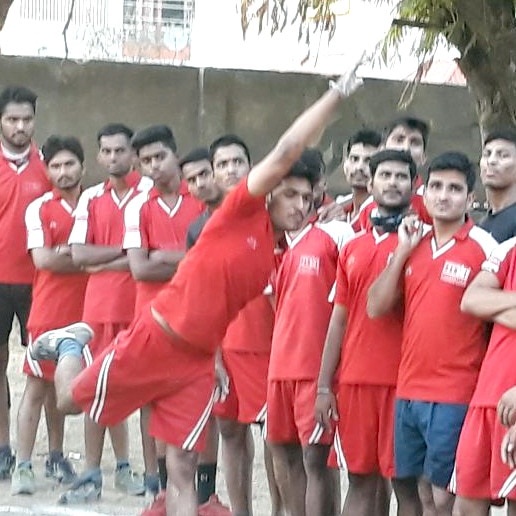 | Training Academy ₹17000 * पोलीस भरती पूर्व प्रशिक्षण कालावधी 5 महिने * सोबत अभ्यासिका * मैदानी व लेखी परीक्षेची संपूर्ण तयारी * ग्राऊंड किट्स व नोट्स * प्रत्येक आठवड्याला... View product → |
 | Training Academy Staff Selection Commission {GD} ₹17000 Darji Police (pre) Academy is known academy in Maharashtra since 1998 in Jalgaon.All facilities available for boys and girls. View product → |
Frequently asked questions
What physical standards apply to RPF, SSC GD and Maharashtra Police Bharti?
The article explains how PET events such as running, sprinting, jumping or throwing differ from PMT checks for height and chest, and from the recruitment medical examination.
How does an academy turn current fitness into a weekly progression plan?
It should assess your baseline performance, set measurable running and strength targets, schedule recovery, and increase training load in controlled steps.
What should the daily schedule, attendance rules and equipment look like?
Expect a defined timetable, attendance and make-up rules, suitable running space, basic training equipment, timed practice and progress records.
How should trainers handle injuries, heat, recovery and the medical examination?
Trainers should modify sessions for injuries, provide heat and hydration precautions, schedule recovery, and explain medical checks including eyesight, colour vision and musculoskeletal fitness.
What exam guidance and academy support should you expect before enrolling?
Ask whether the academy provides current notification guidance, application and document checks, written test preparation, mock assessments, interview practice and medical-exam guidance.
Related products
 | Sarav Paper With Solution ₹399 आगामी भरतीसाठी अत्यंत उपयुक्त अतिसंभाव्य प्रश्नपत्रिका सोडविण्याचा सराव ऑनलाईन फी जमा करून घरबसल्या प्रश्नपत्रिका सोडवा. View product → |
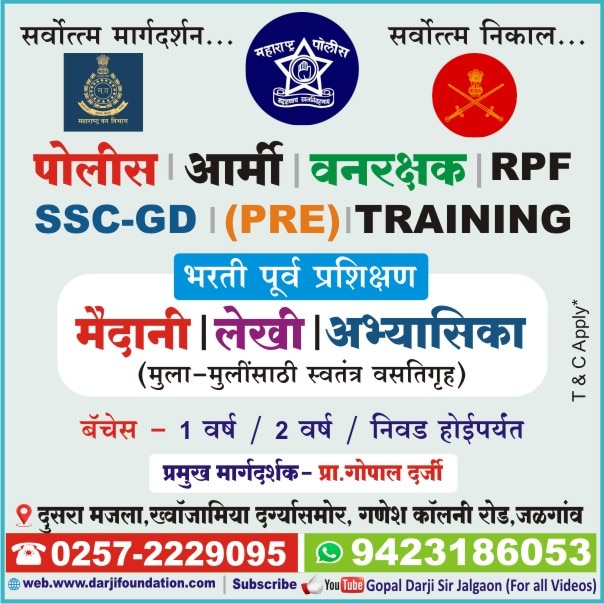 | पोलीस व सैन्य भरती पूर्व प्रशिक्षण POLICE / ARMY / FOREST / RPF / SSC-GD (PRE) TRAINING ₹34000 पोलीस /सैन्य/ वनखाते/ एस.एस.सी.जीडी व इतर भरती पूर्व प्रशिक्षण यांचा कालावधी 1 वर्षाचा असून यात उमेदवाराची मैदानी सराव तसेच लेखी परीक्षासह अभ्यासिका... View product → |