


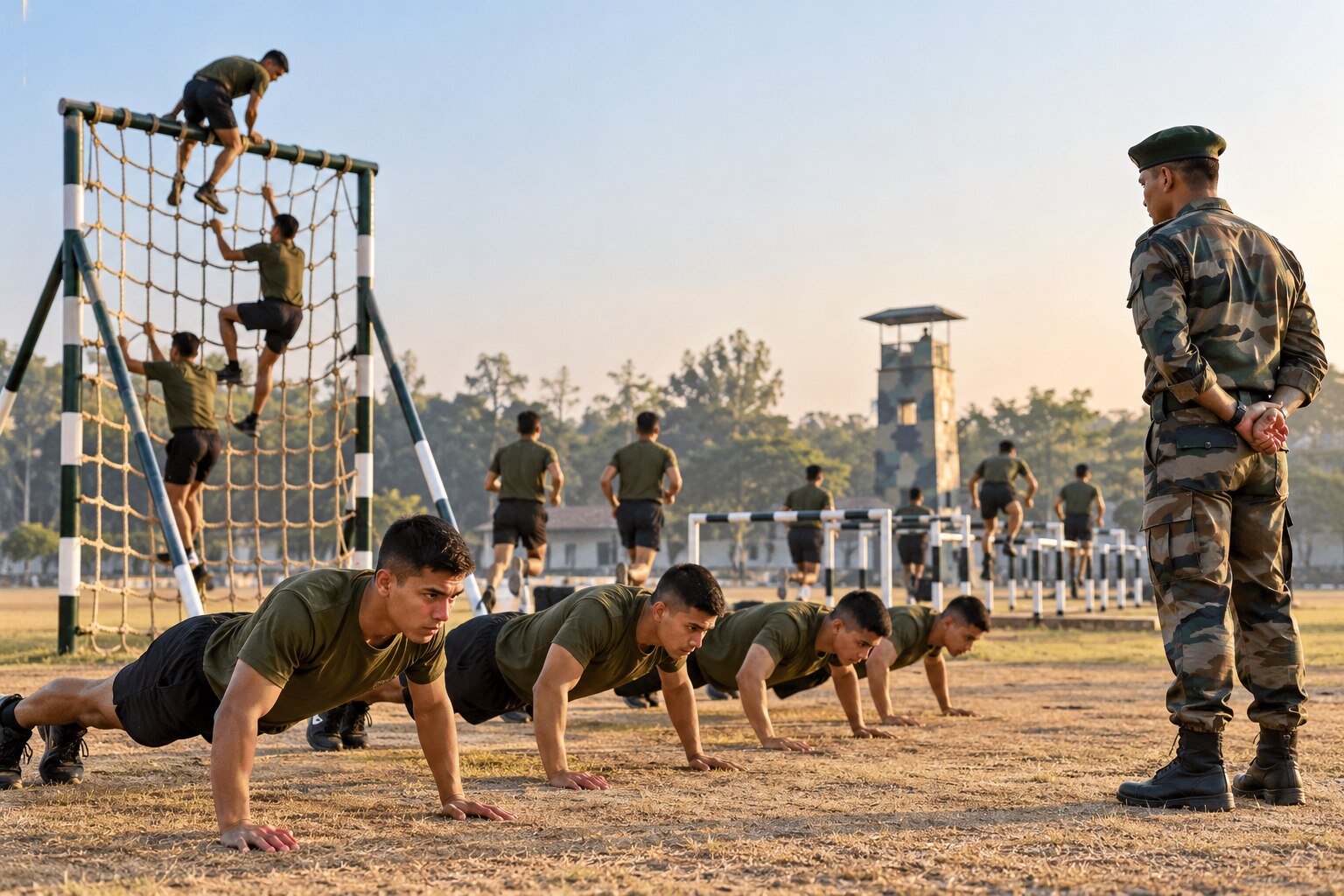
A candidate can run well and still lose a recruitment opportunity through poor pacing, weak pull-ups, an unchecked eligibility problem, missing documents or a low CEE score. A useful academy turns these risks into a measured routine: verify the notification, enforce daily standards, build fitness progressively and rehearse every selection stage.
Key takeaways
- Choose fixed reporting times, attendance records and phone-free training periods.
- Build fitness with progressive running, strength, mobility and recovery—not daily maximum tests.
- Demand timed-test records, attendance data and physical benchmarks showing measurable improvement.
- Check medical fitness, documents, eligibility dates and selection-stage requirements before training.
How does an academy turn discipline into a daily operating system?
Discipline becomes an operating system when every expectation is visible and recorded. The academy sets a fixed reporting time, keeps attendance records, notes late arrival or early departure, and checks uniform rules and grooming standards at entry. Phones stay away during ground and study periods.
1. Apply a clear consequence ladder: repeated lateness brings a warning and parent or guardian contact; missed study work receives a corrective assignment; an unexplained absence requires a review before the candidate returns.
2. Use coaching, not humiliation. Punishment runs and sleep deprivation are poor substitutes for instruction because they damage recovery, concentration and training quality.
3. Follow a weekday structure: 5:30–6:00 warm-up and mobility; 6:00–7:00 running or event practice; 7:00–7:30 strength and cooldown; daytime recovery; 4:00–5:30 notification-specific written study; 5:30–6:00 error review.
4. Set a weekly pattern with easy running, intervals, strength, drill, one mock paper, one full physical rehearsal and at least one recovery day. Selection-supporting discipline also means arriving punctually, sleeping enough, hydrating, preparing equipment before training and reporting pain early. A candidate who hides pain can turn a manageable problem into a missed test.
How is Army fitness built without treating every session as a maximum test?
A 1.6-kilometre run improves through pacing, not daily exhaustion. Begin with brisk walking, easy jogging, leg swings and shoulder mobility, then progress weekly: easy aerobic runs build capacity, short sprint intervals develop speed, and occasional full-distance trials test pacing through split times. Do not add daily timed runs or high-volume pull-ups at once.
- Build push-ups and sit-ups with strict, repeatable form; increase sets gradually.
- Train pull-ups from the evaluator’s required starting position and use the official counting method. Partial repetitions create false confidence.
- Add long jump, high jump, the 9-foot ditch and zig-zag balance through supervised technique, then progress from soft landings and low obstacles to full efforts.
- Practise every other event named in the current notice, not only running.
| Session type | Main purpose | How to use it |
|---|---|---|
| Easy aerobic run | Endurance and recovery | Conversational pace between hard sessions |
| Sprint intervals | Speed and finishing power | Short repetitions with complete recovery |
| Full-distance trial | Pacing and readiness | Occasional 1.6-kilometre effort using recorded splits |
| Strength and obstacles | Event-specific control | Strict repetitions, safe landings and gradual height |
Wear footwear with a secure heel and suitable grip. Drink water before and after training, and leave rest between hard sessions. Stop for chest pain, faintness, severe breathlessness, sharp pain or altered movement; seek medical advice for persistent shin, knee, ankle or shoulder pain.
Army, RPF Constable, SSC-GD, police and Forest Department notices differ. No single advertised height, chest measurement, distance or timing applies to every recruitment.
How does an academy prove that a candidate is improving?
A credible academy starts with a baseline fitness test before training, not a promise based on appearance. Record the 1.6-kilometre timing record with split times, maximum strict pull-ups, fixed-form push-ups and sit-ups, sprint or jump results, body weight, recovery time, and a mobility or injury check.
Retest the same events every three or four weeks using identical standards.
- Log every session’s attendance, running pace, repetitions, rest intervals and pain reports. These records show whether a candidate is improving or merely attending.
- Run a timed written paper weekly or fortnightly from the current CEE or recruitment syllabus. Record the mock-test score by subject, unanswered questions, wrong answers and time lost.
- Convert the results into an individual corrective plan. Use pacing work for a fast start followed by a slow finish, assisted pulling for weak upper-body strength, landing drills for poor jump technique, and error notebooks plus timed section practice for written-test gaps.
- Review the plan after each retest. Change the method when the weakness does not move: add closer technique supervision, adjust training load or arrange medical review.
Attendance percentage alone is not progress. A candidate who attends every session but cannot improve a measured weakness needs a different method, not another attendance certificate. Pain, altered movement or declining recovery also demands attention before harder training continues.
What must be checked before training and before the selection stages?
1. Complete eligibility verification before selling a training plan. Read the current recruitment notification and record the candidate’s age on its cut-off date, age and education, nationality, height and chest measurement, weight, eyesight, and category or regional conditions. Do not apply a height or chest rule copied from another recruitment.
2. Compare every document line by line. Check the candidate’s name, date of birth and spelling on Aadhaar or another accepted identity document, school certificate, domicile certificate, caste or category certificate, photographs, and any service or relationship certificate named in the notice.
Missing originals or mismatched spellings can delay document verification even after strong physical performance.
3. Map the actual selection sequence before planning classes. For Army recruitment that requires it, the route is online application and fee, Common Entrance Examination, shortlist, physical measurement test, physical efficiency or fitness test, document verification and medical examination, followed by the final merit or joining list.
Use the current notice for exact thresholds and dates.
4. Explain the decision boundaries clearly: the recruiting authority, not the academy, decides eligibility, physical qualification, medical fitness and final selection. Army medical review can assess eyesight, hearing, dental condition, musculoskeletal problems, old injuries and other standards. Coaching cannot guarantee medical clearance.
5. Update the audit whenever the notification changes. RPF, SSC-GD, police and Forest recruitment use different conditions, so copying their rules can produce the wrong application or training target. Keep written confirmation of each checked item and tell the candidate which requirement still needs official verification.
How should you judge an academy before enrolling?
Ask for evidence before paying. This Army training academy comparison checklist separates coaching quality from publicity, including for a local option such as Darji Foundation Jalgaon.
1. Ask to see the current recruitment notification the academy follows. Confirm every event practised: 1.6-kilometre running, sprinting, push-ups, sit-ups, pull-ups, long jump, high jump, the 9-foot ditch and zig-zag balance. Ask how strict repetitions are counted, how obstacle technique is judged, and who supervises running, jumping and strength work.
2. Request anonymised progress records showing 1.6-kilometre times, pull-up counts, attendance percentage, mock CEE marks and document status. Ask how written papers are timed and reviewed, how eligibility is screened, and what happens after a missed session.
3. Inspect the timetable for recovery, injury reporting, technique correction and easier sessions—not only daily maximum-effort runs. Ask to read the injury-management procedure, including who records pain and when training stops or medical advice is required.
4. Get the fee and refund terms in writing, including batch-change rules. Treat pass-out photographs, total enrolment and promises of guaranteed selection or medical clearance as weak evidence.
A credible academy improves preparation and exposes gaps; it cannot control vacancies, competition, the recruiting authority’s measurements, medical decisions or final merit. Compare written answers and observed supervision, not slogans.
Related products
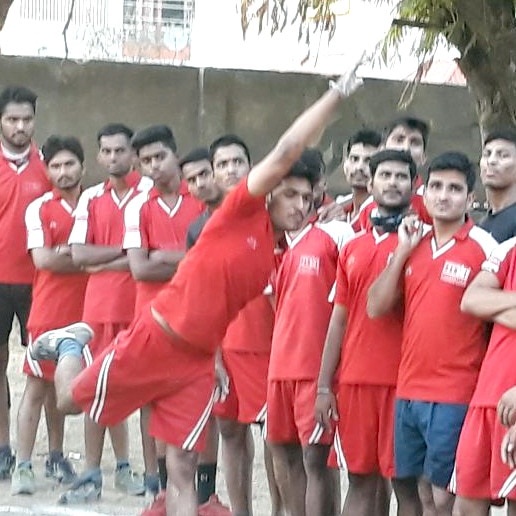 | Training Academy ₹17000 * पोलीस भरती पूर्व प्रशिक्षण कालावधी 5 महिने * सोबत अभ्यासिका * मैदानी व लेखी परीक्षेची संपूर्ण तयारी * ग्राऊंड किट्स व नोट्स * प्रत्येक आठवड्याला... View product → |
 | Training Academy Staff Selection Commission {GD} ₹17000 Darji Police (pre) Academy is known academy in Maharashtra since 1998 in Jalgaon.All facilities available for boys and girls. View product → |
Frequently asked questions
How does an academy turn discipline into a daily operating system?
It makes expectations visible through fixed reporting times, attendance records, late-arrival notes, uniform and grooming checks, and phone-free ground and study periods.
How is Army fitness built without treating every session as a maximum test?
A sound programme uses progressive running, strength, mobility and recovery sessions, reserving timed tests for regular performance checks rather than every workout.
How does an academy prove that a candidate is improving?
It records attendance, running times, repetitions, distances and test scores, then compares dated results against earlier benchmarks.
What must be checked before training and before the selection stages?
Check medical readiness, age and education eligibility, identity documents, application deadlines, physical standards and the exact requirements for each selection stage.
How should you judge an academy before enrolling?
Ask to see the timetable, attendance process, coach qualifications, progress records, injury-prevention practices, mock tests and selection-stage support.
Related products
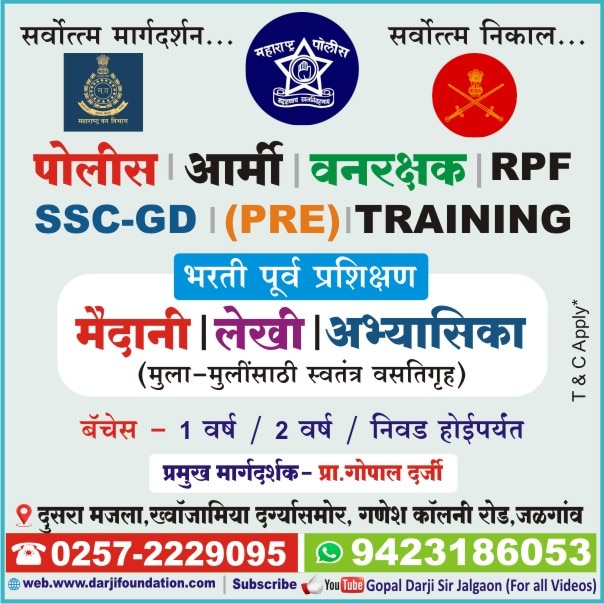 | पोलीस व सैन्य भरती पूर्व प्रशिक्षण POLICE / ARMY / FOREST / RPF / SSC-GD (PRE) TRAINING ₹34000 पोलीस /सैन्य/ वनखाते/ एस.एस.सी.जीडी व इतर भरती पूर्व प्रशिक्षण यांचा कालावधी 1 वर्षाचा असून यात उमेदवाराची मैदानी सराव तसेच लेखी परीक्षासह अभ्यासिका... View product → |
 | Interview CAPF Mock Interview Prepration ₹15000 Darji Foundation Jalgaon Contact: 0257-2229095 View product → |