


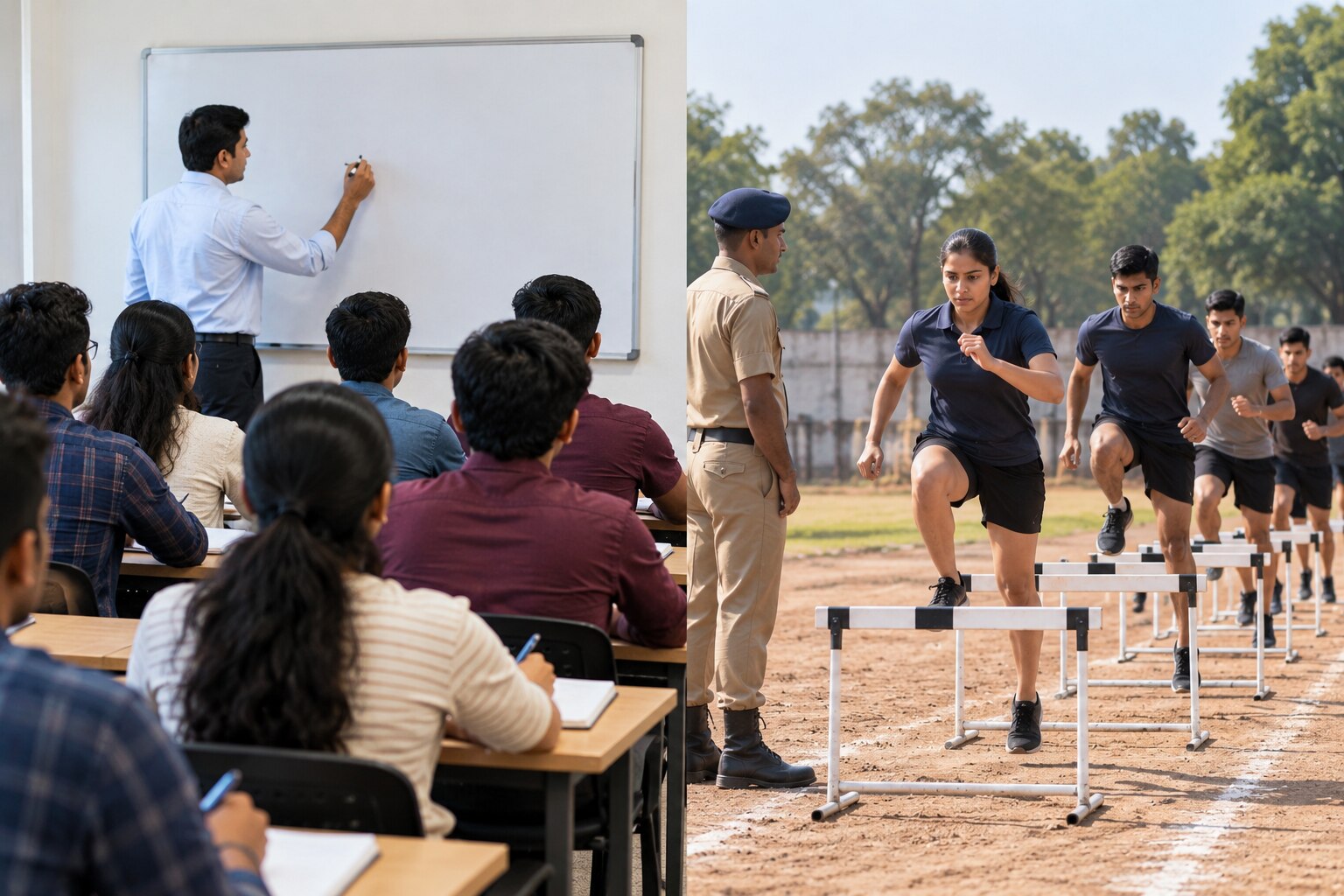
PSI preparation demands two parallel systems: a written plan built around the current MPSC notification and physical training that develops speed, endurance and movement quality without causing injury. By the end, you will have a syllabus checklist, a weekly schedule, a physical-progress log and a method for choosing mocks, coaching or self-study.
Key takeaways
- Download the current Maharashtra PSI notification before selecting books or planning preparation.
- Convert every syllabus topic into a checklist with revision and mock-test targets.
- Record running, strength and event-specific results to measure physical-test progress.
- Review mock-test errors by subject, question type and time lost.
Build Your PSI Plan From the Current Recruitment Notification
Before you choose books, download the Maharashtra PSI notification for your examination year. It controls MPSC PSI eligibility, the PSI exam pattern, reservation conditions, application dates, documents, and physical-test rules; older coaching notes cannot replace it.
Confirm these points directly in the notification:
- Age limit, educational qualification, Marathi-language requirement, reservation category conditions, and fee rules.
- Prelims and mains subjects, marks, duration, negative marking, qualifying conditions, and selection stages.
- Physical events, distances, qualifying standards, timing method, measurement procedure, and reporting instructions.
- Required certificates, photograph and signature specifications, name consistency, and document-verification deadlines.
- Medical requirements, including eyesight or other conditions that could affect eligibility.
| Information source | Use it for | Risk if you rely on it alone |
|---|---|---|
| Official current notification | Your eligibility, papers, physical events, documents, and deadlines | None when followed correctly |
| Previous-year notification | Spotting changes and planning provisional study | Rules may no longer apply |
| Coaching notes or old videos | Explanations, practice, and strategy | Changed standards or paper structure can leave gaps |
Start written study and physical training together. Train to the notified movement, distance, and timing method—not a remembered batch standard—and resolve certificate, name, or medical issues before the application deadline.
Turn the PSI Syllabus Into a Subject-by-Subject Checklist
Use the current PSI syllabus as a checklist, then give prelims and mains different jobs: prelims builds broad coverage and speed; mains demands deeper recall, language accuracy and timed application.
| Stage | Main focus | How to prepare |
|---|---|---|
| Prelims | Maharashtra history, Indian polity, Maharashtra geography and economy, current affairs, science, environment, and aptitude or reasoning where listed | Finish one reliable basic source per subject, solve previous papers, and practise timed mixed questions |
| Mains | The subjects and language papers specified in the notification, with greater depth and precision | Write sectional tests, review explanations, practise Marathi and English comprehension, and revise Maharashtra-specific facts repeatedly |
Tick these areas while mapping the PSI syllabus:
- Maharashtra history: social reformers, movements, administration, culture and the freedom struggle.
- Indian polity: the Constitution, fundamental rights, Parliament, state government, judiciary, elections and local self-government.
- Maharashtra geography and economy: rivers, soils, agriculture, industries, population, budgets, schemes and regional development.
- Science and environment: everyday science, health, biodiversity, pollution, climate and conservation.
- Current affairs: connect state government programmes and major national events to polity, economy, geography, science and environment instead of memorising an unfiltered news archive.
- Marathi and English: practise grammar, vocabulary, comprehension and precise reading every week.
- Aptitude and reasoning: cover only the topics named in the current notification, then track accuracy under negative marking.
Record attempted, correct, incorrect and unanswered questions in every mock. Net score and error pattern matter more than attempts.
Use a Weekly Study Cycle for Prelims, Mains and Revision
Set aside 30 to 36 focused hours each week for a full-time PSI study plan. If you work or attend college, begin with 20 to 24 consistent hours and increase them only when sleep and recall remain stable. Six study days and one lighter recovery day beats seven exhausted days.
Use this weekly division for MPSC prelims preparation:
- 16 to 18 hours for polity, history, geography, economy, science and current affairs
- 5 to 6 hours for Marathi grammar, vocabulary, comprehension and precise reading
- 4 to 5 hours for English, aptitude or reasoning where the current pattern includes them
- 5 to 7 hours for timed questions, previous-paper analysis and error correction
Reserve the final study block of each day for retrieval, not fresh reading. Your revision cycle should include a short review within 24 hours, another after seven days, and a monthly mixed test.
In the last two weeks before prelims, shift at least half your time to revision, timed papers and error logs; stop collecting new books.
After prelims, redirect 24 to 30 weekly hours toward MPSC mains preparation. Write timed answers, revise Maharashtra-specific facts and practise Marathi expression. Use previous MPSC papers diagnostically: label each error as misreading, knowledge gap, weak elimination or time pressure, then apply the matching remedy.
Protect seven to eight hours of sleep; exhaustion reduces recall and test speed.
Train for PSI Physical Events With Measurable Progress
Start the PSI physical test only after reading the current Maharashtra recruitment notification. Record each event, distance, qualifying mark, timing method, permitted attempts and measurement procedure; an old batch’s standard can leave you training for the wrong target.
1. Establish an easy aerobic base with conversational-pace runs. Increase distance gradually, then add intervals such as repeated fast efforts with planned recovery. Do not run an all-out trial every day; shin pain, knee strain and hamstring injuries can interrupt both training and study.
2. Set endurance targets from the notification, not from coaching notes: the required distance, time limit and qualifying condition come first. Practise the exact event movement after your base develops, including the specified running distance and any other listed physical task.
3. Add two strength sessions weekly: squats or split squats, calf raises, hip-hinge movements, push-ups and core exercises. These build force, posture and fatigue resistance, which running alone cannot provide.
4. Maintain a weekly fitness log with date, distance, time, pace, intervals, strength sets, sleep, pain and recovery. Compare like-for-like timed trials every two or three weeks, and reduce intensity if pain changes your running form.
Warm up with easy jogging and dynamic movements before hard work; cool down afterward. Keep one full recovery day, and begin this PSI physical preparation before the written result rather than attempting to recover lost conditioning in the final weeks.
Balance Ground Training, Study, Recovery and the Final Countdown
Reserve one complete rest day each week; exhaustion is not a study strategy. Your PSI physical preparation must run beside written study, not start after the written result.
- Complete five or six focused study days, using timed blocks for revision, practice questions and error review.
- Build two easy aerobic sessions before adding faster running; increase distance gradually rather than sprinting daily.
- Add two strength sessions with split squats, calf raises, hip hinges, push-ups and core work.
- Keep one lighter day for mobility, hydration planning and backlog revision.
- Record study hours, mock scores, running distance, timed efforts, soreness and sleep in one weekly log.
Use the current MPSC notification to confirm the physical events, distances, timing method and qualifying rules. Injury prevention means stopping for persistent shin, knee, ankle or hamstring pain instead of training through it.
| Period | Written preparation | Ground training | Sleep and recovery |
|---|---|---|---|
| Final 30 days PSI preparation | Finish first-pass learning, revise weak topics and take timed mocks | Maintain event-specific practice; avoid sudden mileage increases | Keep a fixed bedtime and protect one rest day |
| Final 14 days | Shift mainly to revision, formulas, facts and error notebooks | Reduce volume while retaining technique and controlled intensity | Stop chasing missed sessions |
| Final 7 days | Review short notes and notification details; avoid heavy new topics | No exhausting experiments or unfamiliar workouts | Prioritise sleep, hydration, meals and travel planning |
A poor night’s sleep can reduce recall and running quality the next day. Arrive fresh, not merely tired from doing more.
Analyse Mocks and Choose the Right Preparation Format
Judge a PSI mock test by its match to the current MPSC pattern, syllabus, Marathi load, time limit and marking scheme. It must reproduce negative marking and reveal net score, not attempts alone.
Record correct, incorrect and unanswered questions; tag each error as knowledge, reading, guessing or time pressure. Review the error log within 24 hours and retake missed questions closed-book.
| Option | Choose when | Risk |
|---|---|---|
| Coaching | Need guidance and accountability | Passive attendance |
| Self-study | Can diagnose errors alone | Blind spots |
| Online tests | Need timed repetition | Weak feedback |
| Library | Need quiet fixed hours | No teaching |
| Hybrid | Need flexibility plus review | Requires planning |
Choose the format that fixes your weakest link. A PSI coaching centre should show subject-wise accuracy, time loss and error trends, not just ranks. At Darji Foundation Jalgaon, ask whether mock reviews provide those measures. A hybrid plan combines guided review, library study, online tests and physical training without sacrificing sleep or recovery.
Related products
 | Training Academy ₹17000 * पोलीस भरती पूर्व प्रशिक्षण कालावधी 5 महिने * सोबत अभ्यासिका * मैदानी व लेखी परीक्षेची संपूर्ण तयारी * ग्राऊंड किट्स व नोट्स * प्रत्येक आठवड्याला... View product → |
 | Interview CAPF Mock Interview Prepration ₹15000 Darji Foundation Jalgaon Contact: 0257-2229095 View product → |
Frequently asked questions
Why should you start PSI preparation with the current recruitment notification?
The current Maharashtra PSI notification sets eligibility, the exam pattern, reservation conditions, application dates, required documents and physical-test rules. Older notes cannot replace it.
How can you turn the PSI syllabus into a study checklist?
Divide the syllabus subject by subject, list each topic separately, and mark first study, revision, practice questions and mock-test completion as separate tasks.
How should you organise a weekly PSI study cycle?
Schedule dedicated blocks for prelims, mains, revision and practice tests, then review your progress at the end of each week and adjust the next cycle.
How do you measure progress in PSI physical preparation?
Record your results for each required physical event, track changes across training sessions and increase workload in a controlled sequence while protecting recovery time.
What should you check when choosing a PSI coaching or preparation format?
Compare classroom, online, written, physical, test-series and interview support against your study gaps, schedule, mock-analysis needs and access to ground training.
Related products
 | Interview ₹2000 Darji Foundation Jalgaon Contact 0257-2229095 View product → |
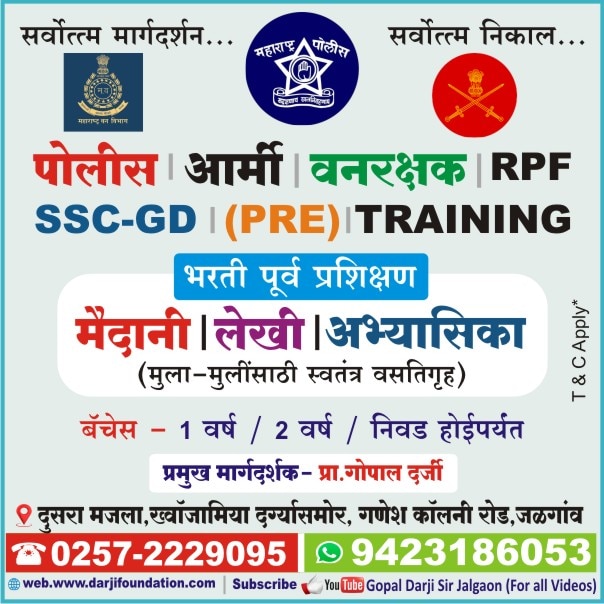 | पोलीस व सैन्य भरती पूर्व प्रशिक्षण POLICE / ARMY / FOREST / RPF / SSC-GD (PRE) TRAINING ₹34000 पोलीस /सैन्य/ वनखाते/ एस.एस.सी.जीडी व इतर भरती पूर्व प्रशिक्षण यांचा कालावधी 1 वर्षाचा असून यात उमेदवाराची मैदानी सराव तसेच लेखी परीक्षासह अभ्यासिका... View product → |