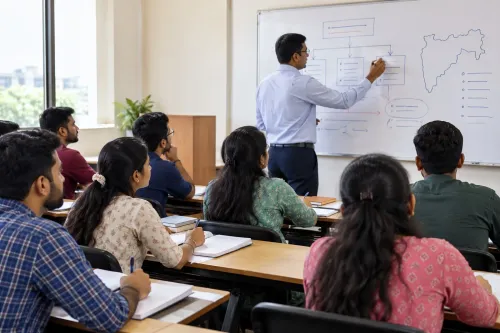



Home preparation works only when you convert the UPSC syllabus into fixed study blocks, timed practice and regular feedback. By the end, you will have a workable weekly routine, a subject sequence, a home-study setup and a checklist for judging whether an online coaching provider actually supports exam readiness.
Key takeaways
- Reserve weekly time for revision, mock tests and complete rest.
- Choose your optional subject using interest, syllabus size and available study material.
- Convert every online lesson into notes, questions, answers or timed practice.
- Check feedback, doubt support, test evaluation and interview preparation before enrolling.
Understand the UPSC Stages Before You Build a Study Plan
The UPSC Civil Services Examination stages require three different preparation modes: objective accuracy for the Preliminary Examination, structured writing for the Main Examination, and reasoned communication for the Personality Test interview.
1. Prepare for the Preliminary Examination as a screening test. Practise timed objective papers, eliminate options carefully, and revise facts, concepts and current affairs repeatedly. Prelims marks are not added to the final merit total, but a weak score ends your attempt before the written papers.
2. Prepare for the Main Examination as a writing competition. It has nine papers: two qualifying language papers and seven merit papers—Essay, four General Studies papers and two papers in one optional subject. The written component carries 1,750 marks. Write within the prescribed word limits, seek answer evaluation, and practise introductions, arguments, examples and conclusions.
Do not ignore the language papers; failing one can cancel an otherwise strong performance.
3. Prepare for the Personality Test interview through discussion rather than memorisation. Review your Detailed Application Form, explain your views clearly, and practise balanced answers on public policy, Maharashtra, your education and current affairs. The interview carries 275 marks and tests judgement, awareness and temperament.
Build your home plan around outputs: timed Prelims tests, evaluated Mains answers and interview practice—not hours spent watching lectures. Compare every book, course and test series with the current UPSC notification, syllabus and previous papers. If you also target MPSC, keep separate syllabus and notification checklists because its papers, language requirements and structure can differ.
Build a Weekly Routine That Protects Revision and Rest
A workable home study routine for UPSC uses fixed blocks, not a growing video queue. Reserve about eight focused hours on six days, then protect one lighter recovery period.
- 6:30–8:00: Revise yesterday’s notes and complete spaced recall from older topics.
- 9:00–11:00: Study one static GS or optional topic, checked against the UPSC syllabus and previous question papers.
- 11:30–12:15: Complete current affairs revision. Convert each issue into a syllabus-linked note with its constitutional, economic, social, environmental or administrative angle.
- 2:00–3:30: Do Prelims preparation through timed multiple-choice questions, elimination practice and error-log review.
- 4:30–6:00: Complete Mains answer writing: two answers within the prescribed word limit, followed by review against model structure and feedback.
- 8:00–8:30: Recall key facts, update your revision tracker and plan the next day.
Keep Saturday for a full-length Prelims or Mains test, depending on your current phase. Spend the same day recording the score, unanswered questions, avoidable errors and topics requiring another revision cycle.
Use Sunday for weekly consolidation: revise the error log, rewrite one weak answer and organise notes. Stop intensive study for at least half a day; sleep, exercise and time away from screens protect recall. Measure progress through test scores, evaluated writing and completed revision cycles—not lecture hours.
When Prelims is close, increase timed objective practice; after its cutoff, shift that block to Mains answer writing and essay practice.
Choose a Subject Sequence and Optional Subject With Evidence
Begin with GS Paper I, but keep CSAT in the weekly timetable from the first month. Use the current UPSC syllabus and previous question papers to check every lecture plan; coaching notes are not the official boundary of examinable content.
- Build GS Paper I foundations, including history, geography, society and culture, then test them with Prelims questions.
- Practise CSAT every week from the start. It is qualifying at 33%, but a weak score can cancel strong GS Paper I performance.
- Add GS Papers II–IV after the first GS foundation: polity and governance, economy and technology, environment and security, then ethics.
- Begin the optional subject early in parallel, giving it two fixed weekly sessions rather than postponing two 250-mark papers.
- Start Essay preparation after covering two GS papers, then write one timed essay each fortnight using the UPSC syllabus and previous themes.
Optional choice should follow evidence, not popularity.
| Option | Evidence to check | Choose it when |
|---|---|---|
| Graduation subject | Your marks, notes and ability to explain core concepts | You can revise it without relearning basics |
| Overlap with GS | Syllabus and previous-paper comparison | It reduces duplication without forcing superficial preparation |
| Study material | One standard text, usable lectures and recent test papers | Sources are complete and repeatedly revisable |
| Answer support | Evaluated copies from a credible reviewer | You can receive specific feedback on structure and content |
| Syllabus size | Number of topics and revision time | It fits your available months and weekly hours |
Download UPSC’s notification, syllabus and papers before deciding. If you also target MPSC, maintain separate checklists because its syllabus, papers and language requirements can differ.
Turn Online Lessons Into Practice, Not a Video-Watching Habit
A laptop or phone, headphones, charger, and backup power keep a disrupted connection from becoming a lost lesson. Add a timer, printed UPSC syllabus, previous question papers, and one notebook or digital file for each subject. Download notes and recorded lectures before your study block if your internet connection is unreliable.
1. Before each live class or recorded lecture, write three questions from the syllabus and previous papers. Keep the official syllabus beside your timetable; a coaching sequence is not the UPSC syllabus.
2. During class, record only definitions, examples, diagrams, arguments, and points you cannot explain. Mark each doubt with a question mark instead of copying the teacher’s entire screen.
3. Within 24 hours, close the lecture and write a five-minute recall sheet from memory. Reopen the material only to correct gaps, then schedule reviews after three days, seven days, and twenty-one days.
4. Send doubts through the provider’s named channel with the topic, your attempted answer, and the exact question. A vague message such as “I do not understand” delays a useful reply.
5. Convert every lesson into output: solve timed objective questions for Prelims and write answers within the prescribed word limit for Mains. Track scores, completion time, repeated errors, and answer evaluation rather than hours watched.
6. End each week with a fixed test and a revision audit. IAS online coaching classes support online UPSC preparation from home only when recorded lectures lead to measurable practice.
Compare Coaching Formats and Check the Provider’s Actual Support
A high-definition live class is not a complete system if a weak connection makes you miss half the lesson. Compare IAS online coaching providers by asking how each format protects your study when your schedule, internet access or concentration fails.
| Option | Useful when | Main risk |
|---|---|---|
| Self-study | You can select sources, plan work and review answers alone | No external correction or deadline |
| Classroom coaching | You need fixed hours, immediate interaction and peer discipline | Travel consumes time; recorded access may be absent |
| Live classes | You need scheduled teaching and real-time questions | A connection failure can remove the lesson |
| Recorded classes | Your work or college timetable changes | Postponement becomes invisible |
| Hybrid UPSC coaching | You want live teaching plus recordings, notes and tests | You may pay for features you never use |
| UPSC test series | You need timed practice and performance tracking | Model answers alone do not improve your writing |
Before choosing between live versus recorded classes, request a sample recording, downloadable notes and the recovery process after a missed class. Darji Foundation Jalgaon is worth comparing on those practical points, not only on its timetable.
- A doubt channel with a stated response time and subject-specific replies
- Mobile-friendly test submission that works on low bandwidth
- Evaluated answers showing errors, not just marks or model answers
- A progress record linking repeated mistakes to later tests
Audit the timetable against the current UPSC notification, syllabus and previous papers. If you also target MPSC, maintain a separate checklist because its syllabus, papers and language requirements differ.
Related product
 | ICDC (Marathi) - 3 Year UPSC/MPSC FOUNDATION COURSE ICDC (Marathi) - 3 Year UPSC/MPSC FOUNDATION COURSE ₹135000 12 वी पास व पदवीला असलेल्या विद्यार्थ्यांसाठी UPSC/MPSC तसेच इतर तत्सम स्पर्धा परीक्षा उदा 1) स्टाफ सिलेक्शन CGL व Matric Level 2) Bank-PO & Clerk 3)... View product → |
Frequently asked questions
What are the stages of the UPSC Civil Services Examination?
The examination has the Preliminary Examination, the Main Examination and the Personality Test, each requiring a different preparation method.
How should you build a weekly UPSC study routine at home?
Set fixed study blocks for lessons, revision, answer writing, mock tests and rest instead of filling every day with video classes.
How do you choose an optional subject for the UPSC Main Examination?
Compare your interest, academic background, syllabus size, past-question papers, study material and access to reliable guidance.
How can you avoid turning online coaching into passive video watching?
Pause lessons to make concise notes, solve related questions, write timed answers and review mistakes after each session.
What should you check when comparing IAS online coaching classes?
Ask how the provider handles doubt resolution, answer evaluation, test-series feedback, technical access, progress tracking and Personality Test preparation.