


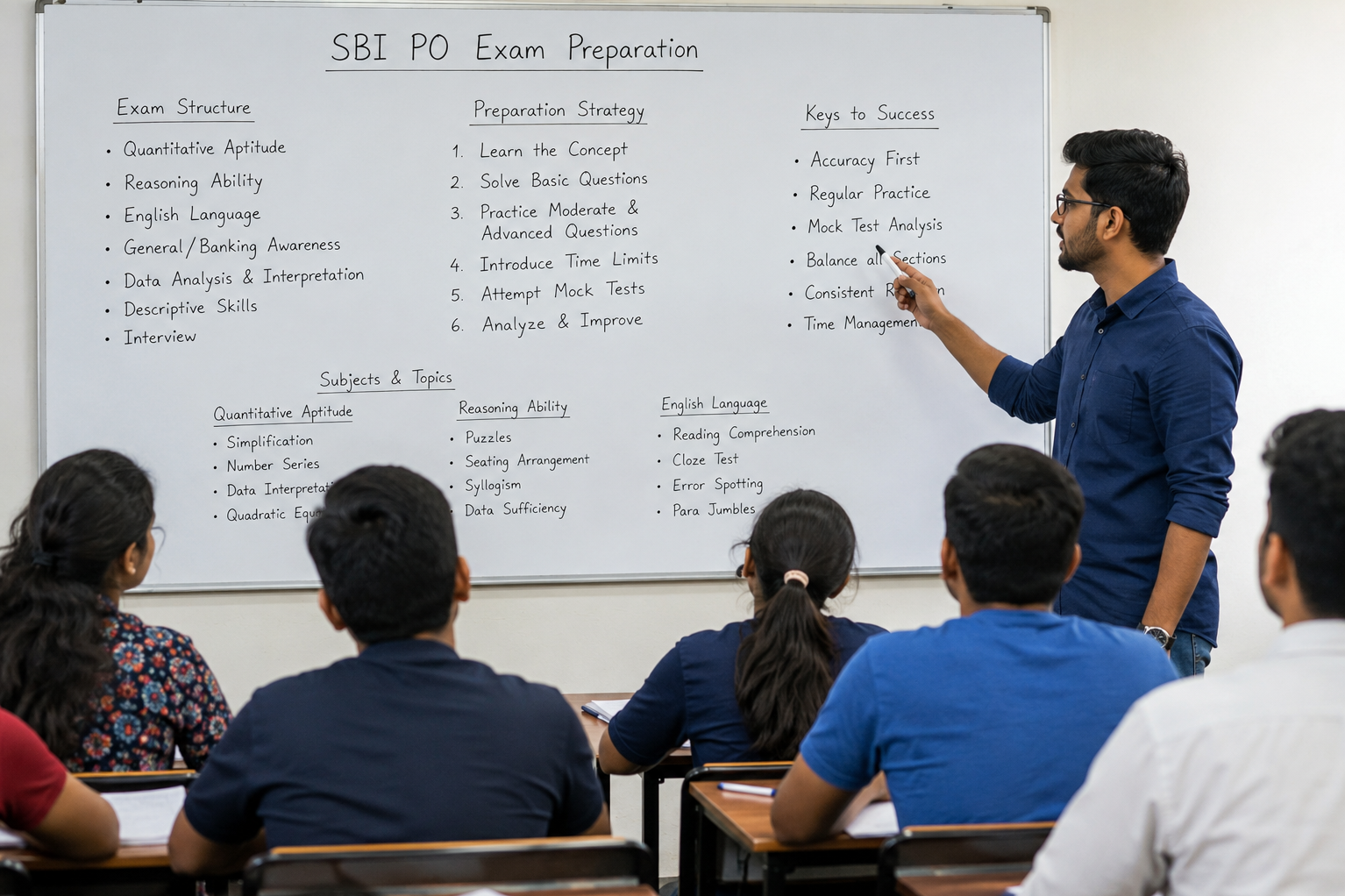
Banking examinations attract graduates from diverse academic backgrounds because they offer structured career opportunities in the public banking sector. Among these examinations, SBI PO remains highly competitive due to the number of applicants and the multiple stages involved in the selection process. Joining an SBI PO Bank coaching centre can help aspirants understand the examination pattern and develop a more systematic approach to preparation.
For students in Jalgaon and other parts of Maharashtra, the biggest challenge is often not a lack of study material. It is deciding what to study, how much time to spend on each subject, and how to measure progress.
Understand the SBI PO Exam Structure
Preparation becomes easier when students first understand what the examination actually tests. The selection process generally requires competence across areas such as:
- Quantitative aptitude
- Reasoning ability
- English language
- General and banking awareness
- Data analysis and interpretation
- Descriptive communication skills
- Interview readiness
Each section demands a different preparation technique. Memorising formulas may help with certain quantitative questions, but reasoning requires repeated exposure to different problem types. English improvement depends on reading, vocabulary, grammar, and comprehension practice.
Build Accuracy Before Chasing Speed
A common mistake among banking aspirants is attempting to solve questions as quickly as possible from the beginning. Speed without accuracy can lead to unnecessary negative marking.
During the initial preparation stage, students should concentrate on understanding concepts and recognising common question patterns. Once accuracy improves, timed practice can gradually be introduced.
A useful progression is:
- Learn the underlying concept.
- Solve basic questions without a timer.
- Practise moderate and advanced questions.
- Introduce sectional time limits.
- Attempt full-length mock examinations.
- Review mistakes after every test.
This approach makes speed the result of familiarity rather than rushed calculation.
Use Mock Tests as a Learning Tool
Mock examinations are valuable only when students analyse them properly. A score alone does not reveal why performance improved or declined.
After each mock test, aspirants should identify questions that were answered incorrectly, questions that consumed too much time, topics that were skipped, and areas where guessing caused negative marks.
Maintaining a simple error notebook can be particularly useful. Recurring mistakes become easier to recognise when they are recorded and reviewed regularly.
Balance Every Section
Bank examination aspirants sometimes spend excessive time on their strongest subject because it feels productive. This can create an imbalance.
A student who performs well in reasoning but repeatedly struggles with English comprehension still needs a plan for improving English. Preparation should therefore include both strength-building and weakness correction.
Students attending Darji Foundation in Jalgaon can use structured classroom guidance and practice schedules to organise their banking exam preparation according to individual learning requirements.
Develop a Sustainable Daily Routine
Long study sessions are not automatically effective. Three focused hours with measurable targets can be more productive than an entire day of irregular study.
A daily plan might include conceptual learning, timed question practice, current affairs revision, vocabulary development, and a short review of previous mistakes.
Weekly revision is equally important because banking preparation involves retaining formulas, shortcuts, vocabulary, current affairs, and problem-solving methods over several months.
SBI PO preparation ultimately rewards consistency. A structured SBI PO Bank coaching centre approach can provide direction, but students still need regular practice, careful test analysis, and disciplined revision to convert preparation into examination readiness.